Monday, March 18, 2013

March 15 Media Appearances

Friday's media appearances - Bloomberg radio ("Taking Stock with Pimm Fox and Courtney Donohoe") and Canada's leading business network, BNN TV - includes many of the items noted in the blog posting below.

To listen to the Bloomberg radio segment live, click here!

To view the BNN TV segment, click here!

Friday, March 15, 2013

Media Appearances today: Bloomberg Radio and BNN TV

Since yesterday was Pi day (3/14), the operative feature for today's media appearances are the numbers 8, 0, 3, and 2.

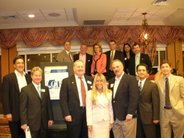
* 8 as in the 8 events that I produced and conducted with 8 different CFA societies in 8 different cities over an 8 week span.
* 0 as in what happens when an economy slips into recession in a zero bound interest rate 0 appetite for fiscal debt environment. Depression, anyone?
* 3 as in the 3 primary forces that move markets and why there is no disconnect between the real economy and the financial markets. Or, why this isn't your grandfather's stock market anymore.
* 2 as in the importance of US real GDP growth at the 2% level.

Note: For the Bloomberg radio segment, Don Rissmiller, Chief Economist with Strategas Research Partners is on the program.

To listen to the Bloomberg radio segment live, click here!

To view the BNN TV segment (when posted), click here!

Thursday, February 7, 2013

Bloomberg Radio "Taking Stock" appearance with Paul Krugman, Rob Johnson, and Bob Massie

I am not sure just how aware most investors are re the crisis in economics, but if my experience conducting events throughout the US is any indication, a very large gap exists between what investors - and even most investment professionals - think they know about economics and what really happens in that world.

Economics may be called the "dismal science" but a failure to appreciate the driving forces behind political power and its use of economic theories such as "expansionary austerity" is to be engaged in what could easily be called "dismal investing".

In case you missed the February 5 discussion with Paul Krugman, Rob Johnson (Institute for New Economic Thinking), and Bob Massie (New Economics Institute), the interviews are available as follows:

To hear the segments, click here!

Sunday, January 13, 2013

December 27 Bloomberg radio's "Taking Stock" segments on Behavioral Finance

Kahneman! Lo!! Catalano?!?

On December 27, I had the privilege of co-producing and appearing as a guest on Bloomberg radio's popular "Taking Stock with Pimm Fox and Courtney Donohoe" discussing the topic of behavioral finance with two of the leading thinkers in the field: Nobel Laureate Daniel Kahneman and MIT professor Andrew Lo. This is the first of what is planned to be a multi-part series on global thematic issues.

As you may know, the topic of behavioral finance fits into the global thematic work that I have been engaged in for quite a number of years. Though hard-to-quantify for traditional investor types (i.e. how does one incorporate it into a valuation model), the discipline is self-evidently important and obvious to anyone who has analyzed the social science called investing. In the process, it cuts right to the heart of the so-called "efficient market hypothesis".

The December 27 segments will help introduce and expand listeners' knowledge of this vital area of investment decision-making research.

To hear the segments, click on the following links:

“Segment #1”

“Segment #2”

“Segment #3”

Tuesday, November 27, 2012

Long Time No Blog

Just in case you were wondering, I have been involved with multiple projects and blogging has, unfortunately, taken a back seat for now. One of the projects involves securing Nobel Laureate Daniel Kahneman and MIT professor Andrew Lo for a special Bloomberg radio segment of "Taking Stock" to be conducted on December 27 beginning at 3:15 PM (eastern). The discussion with the two excellent behavioral finance experts will provide investors with much useful information and, importantly, insights.

Other projects will be noted on this blog from time to time.

Monday, September 10, 2012

Waves, Tides, and Currents

Thanks to producer Paul Brennan and host Pimm Fox, today’s guest co-hosting hour (3 to 4 PM eastern) on Bloomberg radio’s “Taking Stock with Pimm Fox and Courtney Donohoe” affords me the opportunity to explore the major thrust of the research work of Blue Marble Research as well as the newly formed New York Society of Security Analysts’ “Global Thematic Committee”: global thematic issues.

Big picture issues, specifically the ones that wash over business cycles and across economic sectors and industries, are an under developed area of research. This is especially true when you attempt to take it down to the specific investment actionable area. Yet, as the oceanographic analogy below illustrates, global thematic issues are the major force impacting economies, economic sectors, industries, and companies. Three of these global thematic issues will be explored today – politics, innovation, and economy: PIE.

To understand PIE and how the individual global thematic threads are connected one to the other (into what becomes a global thematic picture) is not as easy as pie. It is complicated. Moreover, there is a great deal of dynamism within the global thematic space, where the one constant – change – is ignored at one’s own financial and business peril. Lastly, much of what occurs at the global thematic level is not easily quantifiable.

Now, in the world of traditional economic and financial analysis, when something is complicated, dynamic, and, crucially, hard to quantify it becomes something that investors and analysts acknowledge but have little means to incorporate into their economic, financial and valuation models. This is where most of the Blue Marble Research value proposition lies. A work in progress, for sure, but a goal worthy of the effort, provided the basics of investing (and tools used) are not disregarded.

To be clear, global thematic is not only about top down, secular forces that impact all that lies below. For, what happens at the grassroots company level can often impact the overall environment. (And this is an area of research that can be developed further and incorporated into the global thematic analysis framework.)

So, when you read Wall Street Journal commentary by Charles Koch and listen to today’s Bloomberg radio segment (which can be heard live via bloomberg.com/radio and later via iTunes) along with the research, analysis, and commentary produced in Blue Marble Research reports (as well as blog postings and media and live event appearances) you will hopefully gain what it being attempted: To help subscribers and investors gain an investment competitive advantage and produce alpha (on an absolute and risk adjusted basis).

Now, the metaphor.

Investment Strategy Implications

When you stand on the seashore, you can easily see the waves breaking. If you stand long enough, you will see the tide rolling in and out. But you can stand on the seashore forever and you will never see the most powerful force in the ocean – the current.

To “see” that force requires the right kind of instrumentation and an understanding of how that force impacts the visible parts of the whole. So, perhaps with some hard work and a little luck we can get our investment feet and heads out of the bottom up/traditionally oriented analytical sand and discover the mega forces at work in today's changed global economic and market structures.

Interconnected, dynamic, and complex. That is the real world of the oceans. That is the real world of investing.

Tuesday, August 7, 2012

Sorkin Too Simplistic

The following is my submitted reply to a commentary by Andrew Ross Sorkin in today's NY Times -
Why Investors Are Fleeing Equities? Hint: It's Not The Computers

Sadly, this commentary is just too simplistic. Andrew must be spending too much time in the sound bite world of CNBC.

To understand WHY INVESTORS ARE OUT OF EQUITIES, one needs to go much deeper. For while there are areas of Andrew's commentary that are accurate, the full story is far more complex.

Individual investors are out of the DIRECT OWNERSHIP OF EQUITIES but they are very much IN equities via mutual funds (often through their IRAs), hedge funds, and ETFs. All one needs to do is look at the Fed's Flow of Funds quarterly report to see clear evidence of this*. But this is the data of something more significant.

In most cases, the actions taken by individual investors out of direct ownership of equities and into managed money and derivatives (like ETFs) is rooted in a view of a world (socio economic, political, and financial) that is unrecognizable to many. In the case of today's financial markets, it is a world dominated by hedge funds and high frequency trading. In other words, this isn't your grandfather's stock market anymore.

Conclusion: The structure of the financial markets (and the global economy, too) has changed dramatically over the past several decades. Understanding the why of all this requires much more than a snappy commentary written for the sound bite world Andrew now populates. It requires a serious look at the multi level dynamic forces at work in the world today - a world that is quite alien to the average person.

*Mutual fund redemptions may be on the rise but the net value of equity mutual funds owned is much more constant thanks to rising equity prices. Therefore, one could easily argue that individual investors are engaged in prudent asset allocation strategies - i.e. keeping their equity exposure constant.

Monday, August 6, 2012

The Big Picture Comes Into Focus

The self imposed tweet and blog posting sabbatical is ending shortly. Major projects are now in their second and latter stages. One of the projects pertains to a committee being formed under the auspices of The New York Society of Security Analysts (NYSSA) - The Global Thematic Committee. Its mandate is "to explore “big picture” issues – such as behavioral finance, fat tails and black swans, the crisis in the economics profession, and key socio economic and geo political trends and themes." In doing so, the knowledge gained should complement the more traditional methodologies taught to analysts and investors.

Based on years of involvement in the equity analysis field, I have come to the conclusion that a serious deficiency exists within the profession - one that leaves traditionally oriented equity analysts and investors vulnerable to the larger dynamics at work in the global macro (in the broadest of senses) environment. I suspect this is part of the reason why analysts and investors are often blindsided by the once-in-a-century black swan that manages to happen every 5 to 7 years.

To be sure, this is a work in progress. And there is much to be learned in the months and years ahead. I am very excited as to its prospects and the projects to be undertaken, including the Oxford Debate Series to be launched at NYSSA in October, as well as the podcast series to be produced for NYSSA members.

More to come.

Friday, May 25, 2012

Talking Head Alert: Bloomberg Radio today "Beware The Next Black Swan"

Bloomberg radio today around 3:15 PM (eastern). Taking Stock with Pimm Fox and Courtney Donohue getting deep in the woods on Black Swans, the changed market structure, bell curves and power laws, and why it's no longer your grandfather's economy or market.

All the things you want to hear the Friday before the long Memorial Day weekend.

To hear the discussion tune in to your Bloomberg radio station or click here

Monday, May 21, 2012

May 17 CFA Virginia Presentation: "Beware The Next Black Swan"

Last Thursday, I had the privilege of presenting to the members of the CFA Virginia society a presentation on certain big picture issues and their tendency to produce and/or exacerbate Black Swans. This presentation is part of a newly formed think tank at The New York Society of Security Analysts that I created and is in the process of developing key concepts and producing events therefrom*. While still very much a work in progress, the research work offers much help and hope to those interested in understanding big picture issues and why current research methodologies appear to be less than fully adequate to the times we live and invest in.

Big picture issues, such as globalization, innovation, and behavioral finance, are those hard to quantify items that many (most?) investment professionals are well aware of but have little to no ability to put into their valuation models because they are ... (you guessed it) hard to quantify. Investors know they matter but just how does one incorporate a changed market structure into a CAPM? You can't, therefore, you don't, therefore, when they have this nasty way of bringing about and/or exacerbating a Black Swan you are surprised.

As I said, this is a work in progress and there is much left to do. Thus far, however, the two presentations made to CFA members of Virginia and Nashville (March 28)** have produced very useful comments and suggestions and NO PUSH BACK on the main points. So far, so good.

To view the presentation, click here

Note: Comments and other feedback are most welcome.
*Beginning with an Oxford style debate series at NYSSA this coming October. More details to follow.
**As well as to average investors at The Money Show (May 16).